If someone in your family is struggling with drug or alcohol use, choosing a de-addiction center in Dhaka can feel difficult. I recommend looking beyond advertisements, promises, or the lowest price. A suitable center should assess the person first, understand the substance use and health risks, and then recommend an appropriate treatment plan.
Addiction treatment may involve medical assessment, withdrawal management, psychiatric care, counselling, behavioural therapy, family support, rehabilitation, and aftercare. Not every person needs every type of treatment.
Most importantly, I would never choose a rehab center only because it claims to be the “best.” I would check its licence, clinical team, treatment process, safety standards, family involvement, fees, and aftercare before making a decision.
Treatment should always be based on an individual clinical assessment. WHO and UNODC recommend evidence-based and ethical treatment that matches the needs of the individual.
What Is a De-Addiction Center?
A de-addiction center helps people who are having problems related to alcohol, illegal drugs, prescription medicines, or other substances.
People searching for a rehab center in Dhaka, drug rehabilitation center in Dhaka, addiction treatment center Dhaka, or madok ashokti chikitsa Dhaka may be looking for similar services.
However, not every center provides the same level of care.
Some centers mainly provide residential rehabilitation. Others may offer medical assessment, psychiatric services, counselling, withdrawal management, family sessions, or outpatient treatment.
A person’s treatment journey may look like:
Assessment → Withdrawal management when needed → Psychological treatment → Rehabilitation → Family support → Discharge planning → Aftercare
I would not assume that every patient needs all these steps. The treatment plan should depend on the person’s condition.
When Should a Family Consider Professional Addiction Treatment?
I would consider a professional assessment when substance use is beginning to affect someone’s health, behaviour, relationships, education, work, finances, or ability to control their use.
Possible warning signs include:
- repeatedly trying but failing to stop
- feeling unable to control drug or alcohol use
- needing larger amounts to get the same effect
- experiencing withdrawal symptoms
- ignoring work, study, or family duties
- continuing to use despite health problems
- serious financial problems linked to substance use
- risky behaviour while using drugs or alcohol
- relationship breakdown
- repeatedly returning to substance use after trying to quit
- regularly using several substances together
Families may also notice changes such as secrecy, unexplained absences, major sleep changes, declining work or school performance, unusual mood changes, borrowing or stealing money, or suddenly changing social groups.
However, none of these signs alone proves that someone has an addiction. A proper assessment is important.
When Addiction Requires Urgent Medical Attention
A search for a drug rehab center in Dhaka should never delay emergency medical care.
Get urgent medical help if someone has symptoms such as:
- loss of consciousness
- suspected overdose
- severe trouble breathing
- seizures
- severe confusion
- hallucinations with dangerous behaviour
- extreme agitation
- serious injury
- suicidal behaviour
- immediate risk of harming themselves or another person
In these situations, I would seek emergency medical care rather than trying to transport the person directly to a normal rehabilitation program.
Do Not Assume Detox at Home Is Safe
Families sometimes believe that suddenly stopping drugs or alcohol at home is the safest solution.
That is not always true.
Withdrawal risk can depend on the substance, amount used, duration of use, previous withdrawal history, physical health, mental health, medications, and whether several substances are being used.
WHO guidance notes that severe withdrawal can require medical care, and some withdrawal states can involve seizures, delirium, or other serious complications.
If physical dependence is suspected, I recommend getting withdrawal risk assessed by a qualified clinician instead of attempting an unplanned detox at home.
What Treatments Should a Good De-Addiction Center in Dhaka Provide?
A good addiction program is more than a room where someone stays away from drugs.
I would look for a structured treatment process that addresses the person’s medical, psychological, behavioural, family, and social needs.
Comprehensive Addiction Assessment
Treatment should normally begin with an assessment.
The clinical team may need to understand:
- which substances are being used
- frequency and amount
- how long the person has been using
- previous withdrawal symptoms
- previous treatment attempts
- current medical conditions
- medications
- mental-health history
- family situation
- social environment
- risk of self-harm
- use of multiple substances
Bangladesh’s Department of Narcotics Control has published national guidance on managing substance use disorders, while WHO and UNODC standards also support treatment based on individual needs and clinical assessment.
Medical Assessment and Withdrawal Management
Some patients may require medically supervised withdrawal management.
Withdrawal management helps a person safely pass through the period after reducing or stopping a substance. It should not be confused with complete addiction treatment.
Detox manages withdrawal. Rehabilitation addresses the behavioural, psychological, and social factors that may contribute to continued substance use.
Detox alone is therefore not a complete recovery program.
Psychiatric Evaluation
Substance-use problems can occur alongside mental-health problems.
These may include depression, anxiety, trauma-related problems, sleep difficulties, or other psychiatric conditions.
I would ask whether the center can identify these concerns and whether appropriately qualified mental-health professionals are available or accessible.
Families should not try to diagnose these conditions themselves.
Individual Counselling
One-to-one counselling can help a patient work on issues such as:
- cravings
- triggers
- coping skills
- motivation
- harmful behaviour patterns
- emotional difficulties
- recovery goals
- planning for life after treatment
The actual approach should depend on the individual.
Group Therapy
Well-managed group sessions may help people learn from others, practise communication, receive peer support, and develop accountability.
However, I would not consider group meetings an automatic replacement for individual clinical care when individual treatment is required.
Evidence-Based Psychological Treatment
Depending on the patient’s needs and the professionals available, treatment may include approaches such as:
- cognitive behavioural approaches
- motivational interventions
- relapse-prevention strategies
- contingency-based approaches
- family-based interventions
WHO and UNODC recommend evidence-based treatment services rather than relying only on unsupported or punitive approaches.
Not every addiction treatment center in Dhaka will offer every therapy, so families should ask what is actually provided.
Medication When Clinically Appropriate
Medication may play a role in treating some substance-use disorders, withdrawal symptoms, or related medical and psychiatric conditions.
I would leave medication decisions to appropriately qualified medical professionals.
Families should ask who prescribes medication, who monitors the patient, and how medicines are stored and administered.
Life-Skills and Rehabilitation Support
Recovery often involves rebuilding everyday life.
A rehabilitation program may therefore work on:
- healthy daily routines
- communication
- emotional regulation
- problem-solving
- personal responsibility
- education or vocational preparation
- rebuilding family and social relationships
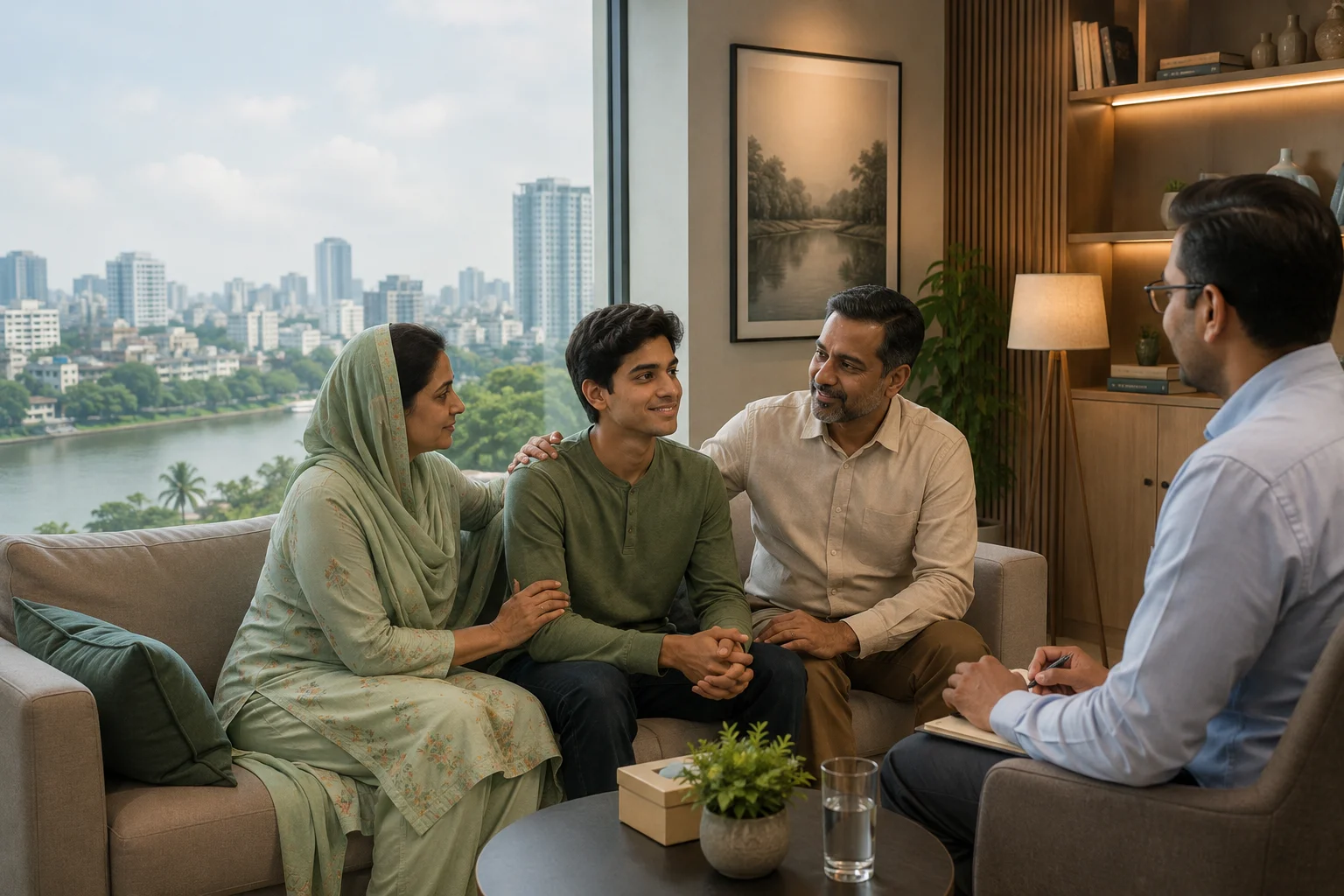
Family Counselling
I consider family involvement especially important.
Addiction rarely affects only one person. Parents, spouses, children, siblings, and other relatives may also experience fear, anger, stress, financial problems, or damaged trust.
Family counselling can help relatives understand recovery, establish healthier boundaries, improve communication, and prepare for the patient’s return home.
Inpatient vs Outpatient Addiction Treatment in Dhaka
There is no single treatment setting that is right for everyone.
| Factor | Inpatient/Residential Treatment | Outpatient Treatment |
| Where the patient stays | At the treatment facility | Usually at home |
| Supervision | More intensive | Less intensive |
| Daily structure | Highly structured | More independence |
| Work or study | Often interrupted | May sometimes continue |
| Family contact | Depends on facility policy | Usually easier |
| Cost | Usually higher | Often lower |
| Best suited for | Depends on clinical assessment | Depends on clinical assessment |
| Aftercare | Still important | Still important |
Who May Need Residential Rehabilitation?
I would discuss residential treatment with a clinician when factors such as these are present:
- more severe dependence
- repeated relapse
- an unsafe home environment
- difficulty staying away from substances outside treatment
- need for more structured supervision
- significant medical or mental-health concerns
- professional recommendation for residential care
WHO guidance also recommends considering inpatient management for people at risk of severe alcohol withdrawal or those with serious physical or psychiatric problems.
Who May Be Suitable for Outpatient Treatment?
Some patients may be able to live at home while attending scheduled treatment.
Suitability depends on factors such as withdrawal risk, stability, home support, substance use pattern, mental and physical health, and the person’s ability to attend treatment safely.
I would make this decision through professional assessment rather than choosing outpatient care simply because it costs less.
How to Choose a Good Rehab Center in Dhaka
When families ask me what makes the best rehab center in Dhaka, I would define “best” as the facility that can safely and appropriately meet the patient’s needs.
It is not automatically the most expensive, luxurious, popular, or heavily advertised center.
1. Check the Centre’s Licence
This is one of the first things I would verify.
Bangladesh’s Department of Narcotics Control publishes rules governing the establishment and operation of private addiction treatment, rehabilitation, and counselling centers. The current DNC website lists the 2021 rules and also provides treatment-centre information.
Ask:
- Which authority issued your licence?
- What is the licence number?
- Is it currently valid?
- Can I see a copy?
- Does the licence cover this particular location?
I would not rely only on a “licensed” badge displayed on a website or Facebook page.
2. Find Out Who Provides Treatment
Ask who will actually care for the patient.
Depending on the services offered, this might include:
- psychiatrists
- doctors
- psychologists
- addiction counsellors
- nurses or paramedics
- therapists
- other trained clinical staff
Where applicable, ask about their qualifications and professional registration.
3. Ask About Assessment Before Admission
I would be cautious if a center recommends a long residential stay without first understanding the patient’s condition.
A safer process looks more like:
Assessment → Recommendation → Individual treatment plan
Be especially careful with statements such as:
“Send the patient immediately. We guarantee recovery.”
No responsible center can know an individual’s outcome before assessing them.
4. Ask How Withdrawal Is Managed
Families should ask:
- Who assesses withdrawal risk?
- Is medical supervision available?
- How is the patient monitored?
- What happens if seizures, severe confusion, or other complications develop?
- What hospital referral procedure is available?
5. Ask to See the Treatment Program
I recommend requesting a sample daily or weekly schedule.
Accommodation, meals, exercise, recreation, spiritual activities, and a drug-free environment may support recovery, but they should not automatically be presented as replacements for appropriate clinical treatment.
Ask how much time is actually spent on assessment, counselling, therapy, rehabilitation work, family support, and recovery planning.
6. Ask About Mental-Health Care
This becomes particularly important if the person has:
- depression
- severe anxiety
- trauma
- major behavioural changes
- suicidal thoughts
- hallucinations
- previous psychiatric treatment
Ask who evaluates mental health and how psychiatric emergencies are handled.
7. Ask How the Family Is Involved
I would ask:
- Are family counselling sessions available?
- How often?
- Who conducts them?
- How do families receive progress updates?
- What can relatives learn before discharge?
- What is the visit and communication policy?
8. Visit the Facility When Possible
Before making a long-term commitment, I would inspect the facility.
Look at:
- cleanliness
- beds and sleeping arrangements
- toilets and bathing areas
- ventilation
- food arrangements
- overcrowding
- security
- privacy
- medication storage
- access to medical help
- general condition of the living areas
9. Ask About Patient Rights and Dignity
Treatment should not remove a person’s basic dignity.
Ask about:
- confidentiality
- respectful treatment
- personal safety
- communication restrictions
- family contact
- complaint procedures
- privacy
- treatment discussions
International WHO/UNODC standards emphasize ethical, evidence-based treatment and respect for human rights.
10. Check the Aftercare Program
I would always ask one important question:
“What happens after the patient leaves?”
A center should be able to explain its discharge and continuing-care process.
15 Questions to Ask a Rehab Center Before Admission
Before choosing a drug rehabilitation center in Dhaka, I recommend asking these questions:
- Are you currently licensed to operate?
- Which doctors or mental-health professionals oversee treatment?
- Who evaluates the patient before admission?
- How do you assess withdrawal risk?
- Is medical supervision available?
- Which therapies and counselling services are included?
- How often does the patient receive individual counselling?
- How do you manage mental-health conditions?
- What does a typical treatment day look like?
- How are family members involved?
- What happens during a medical emergency?
- What are your communication and visiting policies?
- How do you decide how long treatment should continue?
- What exactly is included in the quoted cost?
- What aftercare is provided after discharge?
Clear answers are usually more useful than impressive advertising.
Red Flags When Choosing a Drug Rehab Center in Dhaka
I would investigate carefully before admitting someone if I noticed:
- “100% recovery” or guaranteed-cure claims
- no verifiable licence
- no clearly identified clinical team
- treatment recommended without assessment
- refusal to explain treatment methods
- unexplained or changing fees
- excessive restrictions without a clear reason
- unsafe or overcrowded accommodation
- no plan for medical emergencies
- no clear family communication process
- no discharge plan
- no relapse-prevention or aftercare program
- testimonials being used as proof that everyone will recover
Recovery outcomes vary between individuals. Testimonials can describe one person’s experience, but they cannot guarantee another person’s result.
What Happens During Admission to a De-Addiction Center?
Although every facility may work differently, I would expect a structured admission process.
Step 1: Initial Family Consultation
The family explains the current situation, substance-use concerns, previous treatment, behaviour, and immediate risks.
Step 2: Patient Assessment
The clinical team gathers information directly from the patient whenever possible.
Step 3: Physical and Mental-Health Evaluation
Relevant medical and psychiatric concerns are identified.
Step 4: Withdrawal-Risk Assessment
The team decides whether withdrawal management is needed and what level of medical supervision may be appropriate.
Step 5: Individual Treatment Plan
Treatment goals and interventions are planned around the person’s needs.
Step 6: Treatment Begins
The patient starts the recommended residential or outpatient program.
Step 7: Progress Reviews
The treatment team reviews progress and changes the plan when needed.
Step 8: Family Preparation
Family members learn how to communicate, establish boundaries, understand warning signs, and prepare for discharge.
Step 9: Discharge and Aftercare
Follow-up treatment should be planned before the patient returns home.
How Long Does Addiction Rehabilitation Take?
There is no universal number of days that guarantees recovery.
Treatment length may depend on:
- substance involved
- duration of use
- severity of dependence
- withdrawal risk
- physical health
- mental health
- previous relapses
- response to treatment
- living environment
- support system
- recommended level of care
A person may require short-term medical stabilization, a longer residential program, outpatient counselling, or continuing aftercare.
I would not measure recovery only by how many days someone spends inside a rehab center.
Long-term recovery depends on what happens during treatment and how recovery is supported after discharge.
How Much Does a Rehab Center Cost in Dhaka?
There is no single standard price for addiction treatment in Dhaka.
Costs can vary based on:
- inpatient or outpatient treatment
- length of stay
- shared or private room
- medical supervision
- psychiatric consultations
- medicines
- laboratory tests
- counselling frequency
- accommodation and meals
- emergency medical services
- transport or patient escort services
- aftercare
Rather than comparing only monthly prices, I recommend asking each facility for a written breakdown.
Ask about:
- total estimated treatment cost
- admission or deposit charges
- monthly or program fees
- medicine costs
- doctor fees
- psychiatric consultation fees
- laboratory charges
- emergency costs
- transportation charges
- additional services
- refund or early-discharge policy
Always request the complete fee structure in writing before admission.
Private Rehab Center vs Government Addiction Treatment in Dhaka
Families can consider both private and government treatment options.
The DNC currently lists the Central Treatment Center in Tejgaon, Dhaka among Bangladesh’s government addiction-treatment centres. It also provides information relating to private treatment centres.
Private Facilities
A private rehab center in Dhaka may differ in:
- accommodation
- treatment programs
- location
- cost
- staff availability
- admission waiting time
- family services
Government Services
Government services may provide another treatment pathway, subject to their available programs, eligibility, capacity, and waiting times.
I would not assume that either government or private treatment is automatically better.
Compare the actual clinical services, regulatory status, availability, safety, and suitability for the patient.
Addiction Treatment for Different Substances
Different substances can create different medical and psychological problems.
That is one reason I would avoid a one-size-fits-all treatment plan.
Yaba and Methamphetamine
Treatment should begin with an assessment of current use, physical health, sleep, behaviour, mental health, and other substances being taken.
Some people may experience severe agitation, paranoia, depression, or other mental-health symptoms that require medical assessment.
Heroin and Other Opioids
Opioid dependence requires professional assessment because treatment and withdrawal management may differ from treatment for stimulant drugs.
Medication may form part of treatment when clinically appropriate and prescribed by qualified professionals.
Cannabis
Some people develop significant problems with cannabis even though others may incorrectly believe it can never cause dependence.
Assessment should consider frequency of use and its effect on daily life and mental health.
Alcohol Dependence
Heavy alcohol dependence can involve dangerous withdrawal.
WHO specifically recommends medical management for people at risk of severe withdrawal and notes risks including seizures and delirium.
Sleeping Pills and Sedatives
Some sedative medicines can cause physical dependence.
WHO advises that benzodiazepine withdrawal should normally be planned rather than managed through uncontrolled sudden stopping, because severe withdrawal can occur.
Prescription Medicine Dependence
A medicine being prescribed legally does not mean dependence or misuse is impossible.
A qualified clinician should assess the medication, dose, duration, other medicines, and patient’s health.
Multiple-Substance Use
Using several substances can make treatment more complex.
Make sure the clinical team knows about all alcohol, drugs, prescription medicines, supplements, and other substances being used.
I would not recommend DIY detox instructions for any of these situations.
What Role Should the Family Play in Addiction Recovery?
I believe families can play an important role without becoming responsible for “curing” the person.
Learn About Addiction Without Excusing Harm
Understanding addiction can help families respond more effectively.
But understanding a problem does not mean ignoring violence, stealing, threats, unsafe behaviour, or serious financial harm.
Communicate Without Humiliation
Insults and humiliation can damage communication.
I would focus on specific behaviour instead.
For example:
“You have missed work several times this month, and we are worried.”
That is more useful than:
“You have ruined your whole life.”
Encourage Assessment Instead of Endless Arguments
The first goal does not always have to be convincing someone to accept months of residential treatment.
Sometimes the next useful step is simply:
“Let’s speak with a qualified addiction professional and understand what is happening.”
Set Healthy Boundaries
Families may need clear boundaries around:
- money
- violence
- substance use at home
- borrowing
- vehicles
- children
- household responsibilities
Boundaries should protect the family without being used to humiliate the patient.
Take Part in Family Counselling
Family counselling may help relatives rebuild communication and understand their role in recovery.
Prepare the Home Before Discharge
Talk to the treatment team about triggers, routines, medication, follow-up appointments, money management, old social contacts, and warning signs.
Support Follow-Up Treatment
Completing a residential program should not automatically mean that treatment is finished.
Help the person attend recommended counselling, medical appointments, psychiatric follow-ups, or other continuing care.
Protect Other Family Members Too
Addiction can place severe stress on parents, partners, siblings, and children.
Their safety and wellbeing matter as well.
Family support can contribute to recovery, but family love alone is not a medical treatment for addiction.
How to Talk to a Loved One About Going to Rehab
Choose a time when the person is as calm and clear-headed as possible.
I would avoid starting a major confrontation while someone is severely intoxicated or highly agitated.
Use specific observations.
Instead of:
“You are an addict and you have destroyed everything.”
Try:
“I’ve noticed that you have missed work several times, borrowed a lot of money, and haven’t been sleeping properly. I’m worried and I want us to speak with someone who understands addiction.”
Focus first on assessment.
You do not necessarily need to begin with:
“You have to stay in rehab for four months.”
You can start with:
“Let’s speak with a qualified professional and find out what kind of help you need.”
If the situation involves violence, suicidal behaviour, overdose, severe confusion, seizures, or another immediate danger, prioritize safety and urgent medical assistance.
What Happens After Rehab?
Discharge should be the start of the next stage of recovery, not the end of all treatment.
Depending on individual needs, continuing care may include:
- individual counselling
- psychiatric follow-up
- prescribed medication follow-up
- recovery or peer-support groups
- family counselling
- return-to-work or education planning
- healthy routines
- sleep management
- avoiding high-risk environments
- relapse-prevention planning
Before discharge, I would make sure the patient and family know who to contact if problems begin again.
Relapse Does Not Automatically Mean Treatment Has Failed
Some people return to substance use during recovery.
I would take this seriously, but I would not automatically conclude that all previous treatment was useless.
The safer response is to:
- check the person’s immediate safety
- contact the treatment team
- identify what happened before the return to use
- reassess triggers and risks
- review the recovery plan
- reconsider the level of care if necessary
A return to dangerous substance use should not simply be ignored or accepted as normal. Professional reassessment may be needed.
How Families Can Prepare for Discharge
Before the patient comes home, I recommend checking that:
- follow-up appointments are booked
- the medication plan is understood
- counselling contacts are available
- warning signs have been discussed
- relevant substances are removed from the home where appropriate
- financial boundaries are clear
- a healthy daily routine has been planned
- return to work or education has been discussed
- emergency contacts are available
- family counselling has been arranged if recommended
A written discharge plan can make these responsibilities much clearer.
How to Find a Licensed Addiction Treatment Center in Dhaka
Bangladesh has specific rules for private addiction treatment and rehabilitation facilities.
The Department of Narcotics Control lists the 2021 rules for establishing and operating private addiction treatment, rehabilitation, and counselling centres. DNC also maintains treatment-centre information.
When evaluating a center, I would:
- Check current DNC information.
- Ask the center to provide its licence details.
- Confirm that the licence relates to the location you are considering.
- Ask for the names and qualifications of doctors and mental-health professionals.
- Visit the facility where possible.
- Ask for the proposed treatment plan in writing.
- Request a written fee structure.
- Ask about emergency and hospital-referral procedures.
DNC’s website has also published licensing-related checklists and administrative information for addiction treatment and rehabilitation centres.
Should You Search for the “Best Rehab Center in Dhaka”?
You can search for the best rehab center in Dhaka, but I would change what the word “best” means.
The best center for one patient may not be suitable for another.
I would judge a center by:
- regulatory status
- quality of clinical assessment
- professional qualifications
- appropriate withdrawal management
- psychiatric support
- treatment methods
- safety
- accommodation
- patient dignity
- family involvement
- emergency planning
- transparent costs
- discharge planning
- aftercare
- suitability for the individual’s needs
A beautiful building or a high monthly fee does not automatically mean better clinical care.
Likewise, the cheapest program is not automatically the right one.
Quick Checklist for Choosing a De-Addiction Center in Dhaka
Before admission, I would try to verify each of these:
| What to Check | Verified? |
| Current operating licence | ☐ |
| Qualified clinical team | ☐ |
| Assessment before treatment | ☐ |
| Withdrawal-risk assessment | ☐ |
| Mental-health assessment | ☐ |
| Individual treatment plan | ☐ |
| Individual counselling | ☐ |
| Appropriate group/therapy program | ☐ |
| Family support program | ☐ |
| Safe accommodation | ☐ |
| Emergency procedure | ☐ |
| Transparent written fees | ☐ |
| Confidentiality and patient-rights policy | ☐ |
| Discharge plan | ☐ |
| Aftercare program | ☐ |
Frequently Asked Questions
What is the difference between a rehab center and a de-addiction center?
People often use the terms interchangeably. However, individual facilities can provide very different services. One may focus on residential rehabilitation, while another may offer medical assessment, withdrawal management, psychiatric treatment, counselling, or outpatient care. I recommend checking the actual services rather than relying on the facility’s name.
How do I find a good de-addiction center in Dhaka?
Start by checking whether the center is appropriately licensed and who provides clinical care. Ask about assessment, withdrawal management, psychiatric support, counselling, family involvement, emergencies, fees, discharge planning, and aftercare. If possible, visit the facility before making a long-term commitment.
How can I check whether a rehab center in Dhaka is licensed?
Ask the facility for its current licence details and check relevant information from Bangladesh’s Department of Narcotics Control. DNC publishes regulatory material for private addiction treatment and rehabilitation centers and maintains treatment-centre information.
How much does a drug rehab center cost in Dhaka?
There is no single standard price. Cost can depend on the type of program, treatment length, room, medical supervision, psychiatric consultations, medication, tests, counselling, food, and aftercare. Ask for a complete written fee breakdown before admission.
How long does drug rehabilitation usually take?
There is no fixed treatment period that works for everyone. Duration depends on the substance, severity, medical and mental health, previous treatment, relapse history, home environment, progress, and recommended level of care.
Does every addicted person need inpatient rehab?
No. Some people may require residential care, while others may be suitable for outpatient treatment. A professional assessment should consider withdrawal risk, severity, mental and physical health, home support, safety, and previous treatment history.
Can drug addiction be treated at home?
Some treatment can occur in outpatient or community settings, but families should not assume that withdrawal at home is safe. Certain withdrawal conditions can become serious. A clinician should assess the person and recommend an appropriate treatment setting.
What happens during detox?
Detox or withdrawal management focuses on safely managing the period when someone reduces or stops a substance. The person may be monitored and treated according to their substance use, symptoms, and medical condition. Detox is only one possible part of addiction treatment.
Is detox the same as rehabilitation?
No. Detox mainly manages withdrawal. Rehabilitation focuses more broadly on behavioural patterns, mental health, coping skills, relationships, triggers, routines, and maintaining recovery.
Can family members visit someone during rehab?
It depends on the facility and the person’s treatment plan. Ask about visiting hours, phone calls, family counselling, communication restrictions, and how relatives receive progress updates before admission.
What should I take when admitting someone to rehab?
Every center has different rules. Ask for a written admission list covering identification documents, clothing, toiletries, current prescriptions, medical records, and permitted personal belongings. Do not assume all medications or electronic devices will be allowed.
Can someone relapse after rehabilitation?
Yes, a person may return to substance use after treatment. This should lead to safety assessment and review of the recovery plan rather than automatic assumptions that treatment was useless. Contact the treatment team promptly, especially if the return to use creates overdose, withdrawal, psychiatric, or other safety risks.
What should families do after someone leaves rehab?
Support follow-up treatment, maintain agreed boundaries, understand warning signs, encourage healthy routines, reduce exposure to triggers where possible, and stay in contact with the treatment team. Family counselling may also be useful.
What treatments are available for yaba addiction in Dhaka?
Treatment should be based on individual assessment. Depending on the patient’s condition, care may involve physical and mental-health assessment, counselling, psychological interventions, structured rehabilitation, family support, and treatment of related psychiatric or medical problems.
Are private rehab centers available in Dhaka?
Yes. Bangladesh’s DNC regulates private addiction-treatment, rehabilitation, and counselling facilities and provides information concerning treatment centres. Families should verify the current regulatory status of the specific facility they are considering.
When is addiction a medical emergency?
Seek urgent medical care for suspected overdose, loss of consciousness, severe breathing difficulty, seizures, severe confusion, serious injury, dangerous hallucinations or agitation, suicidal behaviour, or immediate risk of harm. Do not delay emergency treatment while searching for a rehabilitation facility.
Final Thoughts: Choose Treatment Based on Safety, Not Advertising
When I help a family think through addiction treatment, I would keep the process simple:
Verify → Assess → Choose.
Verify the center, its regulatory status, clinical professionals, services, safety standards, and costs.
Assess the patient properly before deciding what type of treatment is needed.
Choose treatment based on clinical need, safety, family circumstances, and continuing-care requirements—not advertising, guaranteed-recovery claims, or price alone.
If your family is considering a de-addiction center in Dhaka, start by speaking with a qualified addiction-treatment or mental-health professional. Ask the facility to clearly explain how it handles assessment, withdrawal risk, treatment, emergencies, family involvement, discharge, and aftercare before you make an admission decision.